
Root cause analysis (D4)
In D4, the team looks for two things: what produced the defect, and what failed to stop it before it reached the customer. Kanriq handles them in two separate trees.
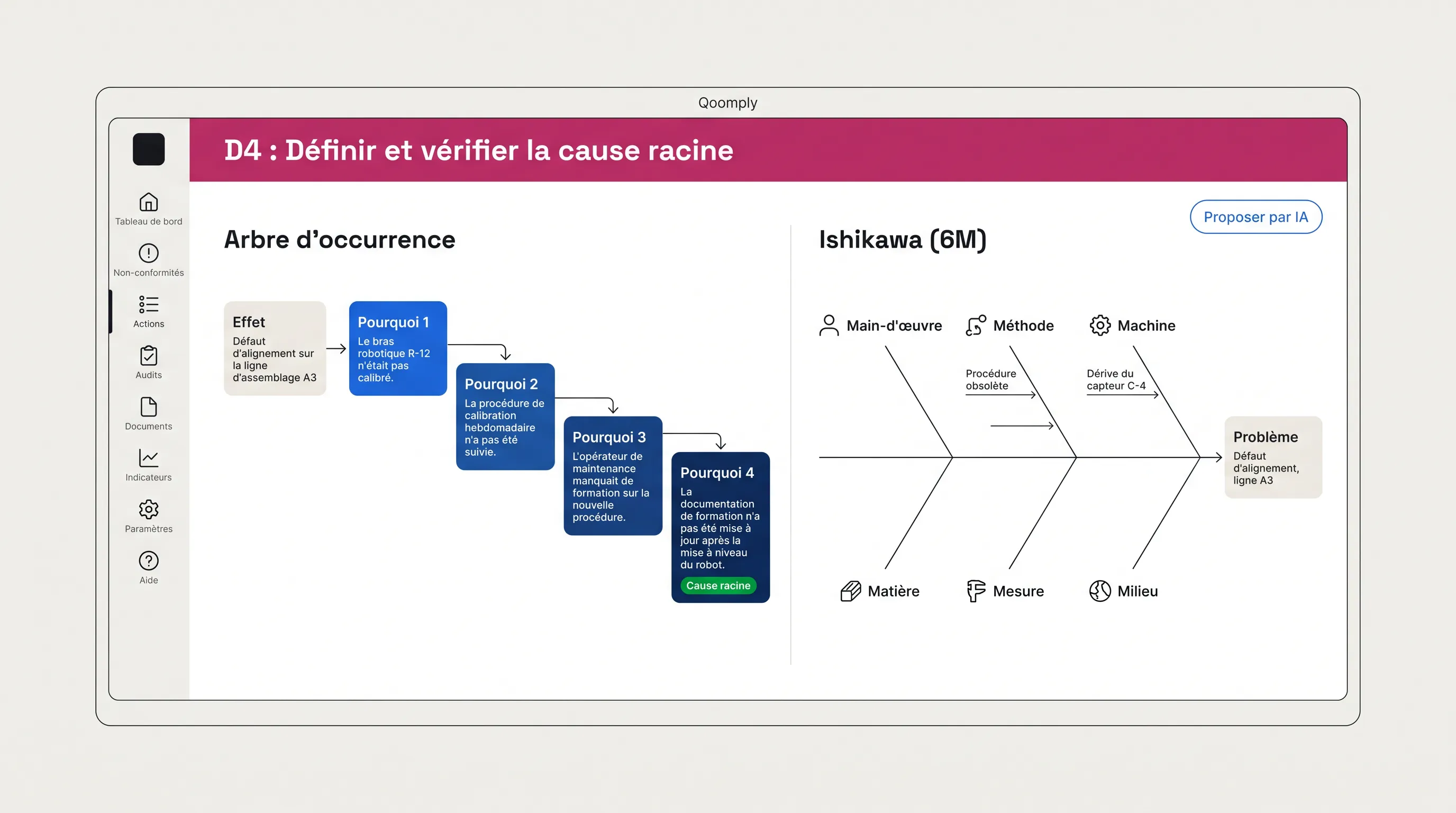
The two 5 Whys trees
Section titled “The two 5 Whys trees”- Occurrence tree — why the defect occurred: process, tooling, settings, material, method, and the rule that governs them.
- Non-detection tree — why the controls did not stop it: what they check, their method, their frequency, and why they were designed or maintained that way.
Each level answers “why” to the one above, down to a cause the team can act on.
- Click Propose tree (AI) under the tree you want.
- Review the cards: a sourced card cites the passage of the case file that supports it; a card marked interpretation goes beyond the file and must be checked.
- Edit a card directly, add a level with +, or split a path into two causes.
- Accept the proposal: nothing is saved before that.
- Answer the verification question — which action validated the cause? (ideally, reproducing the defect) — then click Validate root cause.
Supporting tools
Section titled “Supporting tools”| Tool | What it is for |
|---|---|
| Ishikawa (6M) | Sort possible causes into Manpower, Method, Machine, Material, Measurement, Environment (Milieu). |
| Timeline | Put dated events back in order, from your own words or the facts in the file. |
| Is / Is Not | Pin down the problem on five dimensions: part, operation, machine, period, defect. |
Supporting tools are validated separately and never block closure: only the 5 Whys determines whether D4 can be closed.